
Login
Reset Password
Reset Password
Change Password
Create Account
The Gospel
The numeric patterns detailed on this site cannot save you from your sins. They simply point us to the God who can: the Author of the Bible. He is the true and living God who created all things, and is above all, longsuffering in mercy, eternal, invisible, immortal, and holy in all His being. He created you and He loves you. That was proven ~2000 years ago when the Word became flesh so that He would be crucified at the cross of Calvary, as a sacrifice for all, when he took all our sins and bare them in his own body, cursed, and hanging on the tree in our place. Many people think their good deeds will be good enough to outweigh their bad on the day of judgment. What a terrifying day that will be, as they enter the presence of the Most Holy, having trusted their own goodness and the work of their own hands instead of those blood-drenched hands that were nailed upon the cross. We have all sinned. We are all guilty. We have all come short. The good news is that Jesus, the Son of God, tasted death in our place. Christ died for our sins according to the scriptures; And that he was buried, and that he rose again the third day according to the scriptures: 1 Cor 15:3-4 How do you escape damnation? Call upon the Lord in sincerity. Stop trusting your own hands, and take His. 🤝 Believe on the Lord Jesus Christ, and thou shalt be saved. Visit truthischrist.com/grace for more information.
Amen 77x, Last Word of the Bible
Downloads Download All


…These things saith the Amen…
Revelation 3:14
Amen 77x Last Word of the Bible - Pattern Explanation [19:58]
Summary
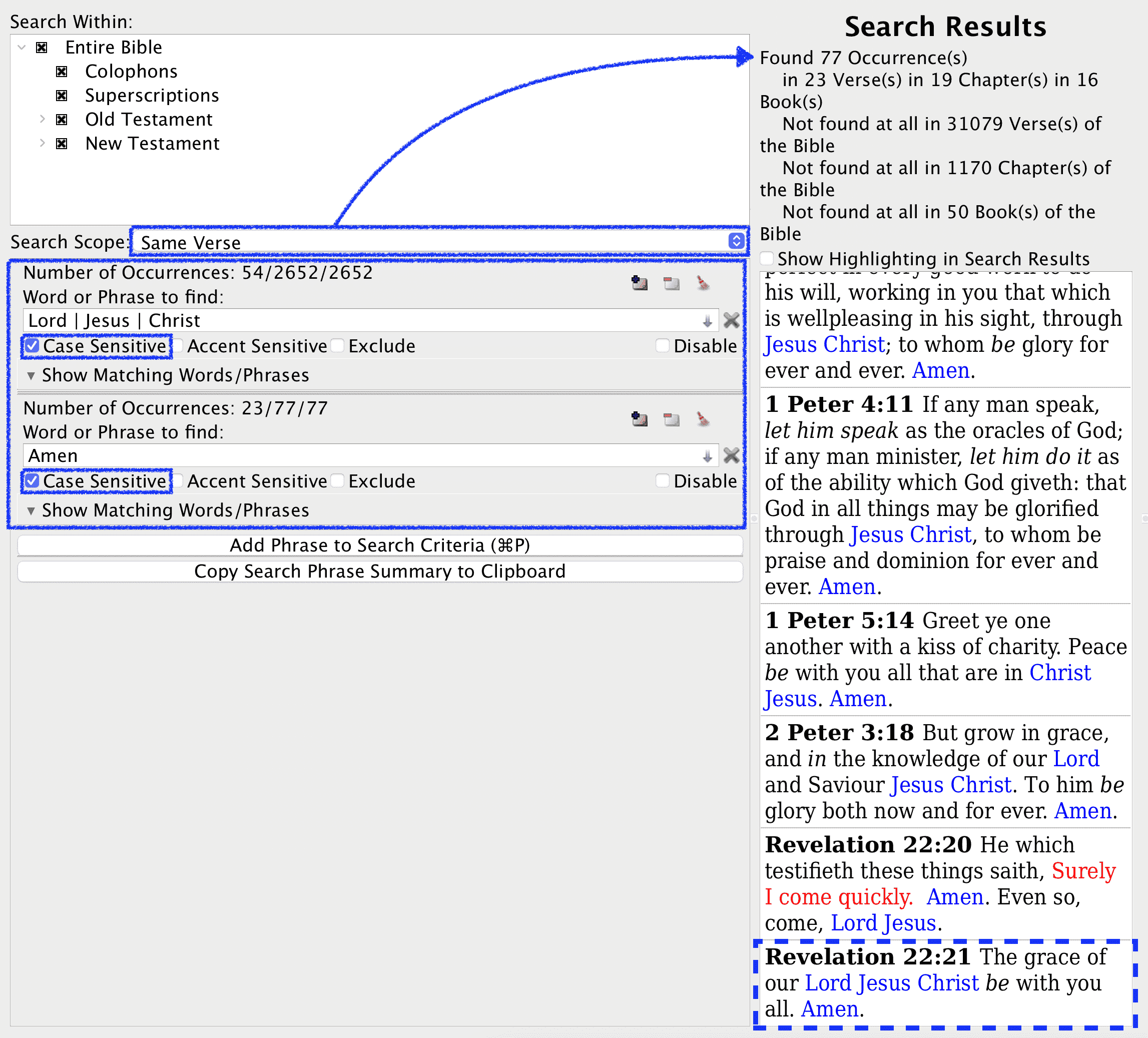
The last word of the Bible is Amen and it is mentioned exactly 77 times when capitalized, or case sensitive.
The grace of our Lord Jesus Christ be with you all. Amen. Revelation 22:21
In the Entire Bible
Amen = 77x (Case Sensitive)
A Precedent for “Fine Tuning”
What makes this pattern truly intriguing is not just the fact that it’s the very last word of the Bible, but also how it wholly depends on capitalization. If we were to count every time “Amen” appears in the Bible without a regard to capitalization (“Amen” or “amen”), we would have 78 mentions, rather than the more captivating 77. The one lowercase mention of “amen” is found in Numbers 5:22, the very first verse where “Amen” shows up in the Bible. It reads:
Numbers 5:22 – And this water that causeth the curse shall go into thy bowels, to make thy belly to swell, and thy thigh to rot: And the woman shall say, Amen, amen.
Notice how “Amen” is repeated twice in this verse, separated by a comma. The first mention is capitalized and the second is lowercase. You will notice this same word structure appear elsewhere in scripture, where “Amen” is repeated two times.
In Psalms, there are three instances that are similar, but not completely identical.
Psalm 41:13 reads, Blessed be the LORD God of Israel from everlasting, and to everlasting. Amen, and Amen.
This is quite similar to Numbers 5:22, except it has the word “and” in between both mentions of “Amen”. Regardless, you would probably expect the second “Amen” to be lowercase in Psalm 41:13 if it consistently followed the pattern of spelling established in Numbers 5:22. The same thing happens in Psalm 72:19 and 89:52.
Psalm 72:19 – And blessed be his glorious name for ever: and let the whole earth be filled with his glory; Amen, and Amen.
Psalm 89:52 – Blessed be the LORD for evermore. Amen, and Amen.
All of this is puzzling, but perhaps explainable as separate types of events, since there is a word “and” in between “Amen, and Amen”. Nehemiah 8:6, however, turns that logic upside down, as we see an even greater match to Numbers 5:22. Look carefully:
Nehemiah 8:6 – And Ezra blessed the LORD, the great God. And all the people answered, Amen, Amen, with lifting up their hands: and they bowed their heads, and worshipped the LORD with their faces to the ground.
Now we can be certain; this is mystery indeed. There truly does not appear to be any consistent rule for capitalization applied across the King James Bible, at least with this particular word. Why is the second “amen” lowercase in Numbers 5:22, but capitalized (“Amen”) in Nehemiah 8:6? Let’s view them side by side so you can see them together:
Numbers 5:22 – …And the woman shall say, Amen, amen.
Nehemiah 8:6 – …And all the people answered, Amen, Amen, with lifting up their hands…
This is not a misprint, or a fluke that is randomly found in a miscellaneous printing of the King James Bible. While some assume there are many textual variations among King James Bibles today, we actually have a settled text in our hands. This specific count (Amen, 77x when capitalized) has remained unchanged since 1629, when Cambridge first started printing King James Bibles. (For more information on the history of why this pattern first formed in 1629 rather than 1611, open the AD 1629 dropdown on this page.)
Now, a passerby who is generally disinterested in the possibility of the King James Bible being God’s perfect word, will simply pass this off as luck, or chance. They have already predetermined that the KJB is full of mistranslations, misprints, errors, and inconsistencies. In their mind, this is simply another example. They will quickly point out that capitalization didn’t exist in the original languages of Hebrew and Greek, and they will move on to the next thing in their day.
But for those of us who are willing to behold the fact that “Amen” shows up 77 times because of this inconsistency, it begs the question: is this a clue to something bigger? Does this “inconsistency” point to a greater divine order? Those who study the Bible know that apparent contradictions often lead to deeper truths. What seems inconsistent in the human mind, is perfectly consistent in the mind of God. We just aren’t looking at it from his lens. And as students of scripture, we know with certainty, that God’s lens involves the number “7.”
If the results showed us something like 55 mentions, or some other number that is less exciting than 77, we probably wouldn’t care. But we know from the plain reading of scripture that God emphasizes the number “7” over and over and over again, to represent rest and divine completion. And we know God places great emphasis on the first and the last. Jesus, the Word of God, is the first and the last (Revelation 22:13). Plus this word, “Amen” is the last word of 24 out of the 27 books of the New Testament. Surely, we have grounds to be curious, and to seek the matter out further, on whether or not this is by chance or by design.
What researchers will find, is that capitalization in the King James Bible is unexplainably fine tuned, to produce counts that appear miraculous, over and over again. There are several times in the Old Testament when lowercase “father” is used instead of capitalized “Father”, even though it refers to God the Father, and even though there is a capitalized mention of “Father” in the Old Testament: in Isaiah 9:6. The same can be said about the word “Son” referring to Jesus Christ. Sometimes it is lowercase, and sometimes it is capitalized. Take a look at the following examples, so you can see for yourself:
- Isaiah 9:6 – For unto us a child is born, unto us a son is given: and the government shall be upon his shoulder: and his name shall be called Wonderful, Counsellor, The mighty God, The everlasting Father, The Prince of Peace.
- Daniel 3:25 – He answered and said, Lo, I see four men loose, walking in the midst of the fire, and they have no hurt; and the form of the fourth is like the Son of God.
- Deuteronomy 32:6 – Do ye thus requite the LORD, O foolish people and unwise? is not he thy father that hath bought thee? hath he not made thee, and established thee?
- Psalm 2:7 – I will declare the decree: the LORD hath said unto me, Thou art my Son; this day have I begotten thee.
- Isaiah 64:8 – But now, O LORD, thou art our father; we are the clay, and thou our potter; and we all are the work of thy hand.
- 2 Samuel 7:14 – I will be his father, and he shall be my son. If he commit iniquity, I will chasten him with the rod of men, and with the stripes of the children of men: (This verse is applied to Solomon in 1 Chronicles 28:6, but to Jesus Christ in Hebrews 1:5).
- Hebrews 3:6 – But Christ as a son over his own house; whose house are we, if we hold fast the confidence and the rejoicing of the hope firm unto the end.
This is not an exhaustive list by any means. But it clearly shows a lack of consistency in capitalization, as we see with “Amen”. What’s amazing is that there are exactly 490, or 70×7 mentions of Father + Son in the King James Bible. 70×7 bears massive significance in scripture, since it is the number that Jesus Christ himself spoke to Peter in Matthew 18:22 to represent complete forgiveness of sins. But again, there are not 490 mentions of Father and Son referring to God and Jesus, there are 490 capitalized mentions of Father & Son, referring to God and Jesus. Case sensitivity logic enables the pattern to exist, where it otherwise would not have.
Perhaps the most astonishing pattern in the Bible, involving the word “Amen” – depends on case sensitive logic- where the first and last words of the first and last verses (Genesis 1:1 / Revelation 22:21) produce a grand total of 77,777 mentions in the entire Bible when consistent case-sensitive logic is applied.
But when it comes to the word “Amen” by itself, the “fine tuning” is not limited to capitalization. Translation choices also affect the count.
For example, in Jeremiah 11:5, the KJB reads, “…Then answered I, and said, So be it, O LORD.”
The words “So be it” are translated from the exact same word in Hebrew as “Amen” (Strong’s #H543). If the translators decided to use “Amen” instead of “So be it,” like the NIV, NASB and NLT (all of which read “Amen” in Jeremiah 11:5), the count would have been offset to 78 mentions rather than 77. (Or 79 mentions, if both mentions of “Amen” were capitalized in Numbers 5:22). But furthermore, in the exact same book, Jeremiah uses the same word in Hebrew, and look at how it is translated:
Jeremiah 28:6 – Even the prophet Jeremiah said, Amen: the LORD do so: the LORD perform thy words which thou hast prophesied, to bring again the vessels of the LORD’S house, and all that is carried away captive, from Babylon into this place.
Why does it read “Amen” in Jeremiah 28 instead of “So be it”, as it reads in chapter 11? It is the same word in Hebrew. It is the same book. It is from the same mouth– from Jeremiah himself. It is even the same company of translators who oversaw these verses. And yet it is translated in two different ways, allowing for the perfect count of 77 mentions in the Bible.
Jeremiah 11:5 – …Then answered I, and said, So be it, O LORD.
Jeremiah 28:6 – Even the prophet Jeremiah said, Amen: the LORD do so…
That word for “Amen” in Hebrew (Strong’s #H543) shows up two other times in the Old Testament when it’s not translated as “Amen”, both of which are in Isaiah 65:16. The King James translators chose the word “truth” instead of “Amen” for both instances, which gives us the reading of: “That he who blesseth himself in the earth shall bless himself in the God of truth; and he that sweareth in the earth shall swear by the God of truth; because the former troubles are forgotten, and because they are hid from mine eyes. For, behold, I create new heavens and a new earth…”
If those mentions of “truth” were word-for-word translated as “Amen”, then the 77 count would simply not exist.
If any of these factors were offset by one, the pattern would be lost, and there would be nothing significant to point out. This page you are reading would not exist. But the astonishing truth is that “Amen” truly does show up 77 times in the King James Bible when it’s capitalized. And if we believe God has finely tuned the world we live in, and our bodies, and our minds, and even our DNA, shouldn’t this “anomaly” in the last word of the King James Bible strike a match in our souls? Should we not light our torches and keep searching for this hidden manna?
Probability and Statistics
There are only 11 words in the King James Bible that are mentioned exactly 77 times, considering both case-sensitive and case-insensitive matches:
- Amen 77x (Case Sensitive)
- Woe 77x (Case Sensitive)
- abide 77x (Case Sensitive)
- hide 77x (Case Sensitive)
- lamb 77x (Case Sensitive)
- ones 77x (Case Sensitive)
- greater 77x (Any Case)
- length 77x (Any Case)
- ones 77x (Any Case)
- rivers 77x (Any Case)
- skin 77x (Any Case)
(Note: “ones” = 77x with or without Case Sensitivity)
Each of these 11 words appears 77 times, so the total number of occurrences among them is:
11 × 77 = 847
The King James Bible contains 790,849 words. For the sake of estimating probability — accounting for both case-sensitive and any-case distributions — we can treat the total pool of possible positions as:
790,849 (case-sensitive) + 790,849 (any-case) = 1,581,698
Thus, the probability that the last word in the Bible is one of the 847 words that appear exactly 77 times is:
𝑃 ≈ 847 / 1,581,698 ≈ 0.0005353
Or roughly: 1 in 1,868
This means there’s about a 1 in 1,868 chance that the last word of the King James Bible appears exactly 77 times in the text.
While this isn’t a perfect way to calculate the odds — since the last word of the Bible theoretically could have been any word (including rare names or proper nouns) — this method provides a conservative estimate based on the actual distribution of words within the KJB itself.
To grasp a 1 in 1,868 chance, imagine flipping a coin 11 times in a row — and landing on heads every single time, which is equivalent to a 1 in 2,048 chance — slightly rarer than 1 in 1,868, but in the same ballpark. Go ahead and give it a shot. If you have the time to flip a coin ~2000 times, you should get a good sense of how unlikely it is for “Amen” to appear as the Bible’s final word by mere chance. And keep in mind, the King James Bible got ~11 heads in a row, first try!
In the Scriptures
While “Amen” is originally a Hebrew word, its prominence does not culminate until the New Testament. In the Old Testament, none of the 39 books end with an “Amen”, but in the New Testament, 24 out of 27 books conclude with this word (every N.T. book except Acts, James, and 3 John). Luke wrote Acts, but the Gospel of Luke concludes with “Amen.” All of John’s writings except for his third epistle conclude with “Amen.” And thus, James is the only New Testament writer who does not end his writing with an “Amen.” Then again, James writes his epistle with a somewhat Old Testament flavor, as it is specifically addressed to “the twelve tribes which are scattered abroad” (James 1:1).
The word “Amen” is a synonym for “So be it” or “This is true” or “truth” (which is quite evident not only from the context in which it is used throughout scripture, but also as we saw previously in Isaiah 65:16, where it’s translated as “the God of truth” instead of “the God of Amen”). Many Christians are unaware that the same word underlying “Amen” in the Greek New Testament (ἀμήν, Strong’s #G281) is also used by Jesus, translated as “Verily” in his famous signature phrase, “Verily, I say unto thee/you…”. Jesus is the only one in the Bible to use this phrase, which is why we call it his “signature phrase.” But instead of saying “Amen, I say unto you…”, it translates as “Verily, I say unto you…”. Remarkably, this translation choice results in yet another profound alignment: Jesus uses his signature phrase exactly 77 times in the King James Bible, precisely matching the 77 occurrences of capitalized “Amen”. This numeric alignment further suggests a deliberate and divine design spreading over the New Testament and the entire Bible (directly from the mouth of Jesus himself).
But if that were not enough scriptural grounds to show the significance of this word, let us now turn our attention to “the Amen” himself. That’s right– “Amen” is a title that Jesus Christ ascribes to himself.
Revelation 3:14 – And unto the angel of the church of the Laodiceans write; These things saith the Amen, the faithful and true witness, the beginning of the creation of God;
The theological significance of Christ adopting the title “the Amen” cannot be overstated—it speaks profoundly of his ultimate authority, finality, and embodiment of truth. Consider how the sixth church, Philadelphia, received praise twice for faithfully keeping Christ’s word (Revelation 3:8,10). Many interpret each church in Revelation as representing a distinct era of church history, with Philadelphia corresponding notably to the period in which the King James Bible was translated. Notice then, how Jesus reveals himself to the seventh and final church, Laodicea, as “the Amen,” the “faithful and true witness”—titles deeply connected with the written word of God. It is as though Christ approaches the Laodicean church age with his completed word, declaring definitively: “It is done. It is finished.” Yet, within this lukewarm church, there remain those who, relying upon their own wisdom, continue searching for the original words of God, unaware that it is “the Amen” himself who stands knocking at the door.
It should be no marvel to us that “the Amen” in Revelation 3:14 is the 7th mention of Amen from the end of the Bible:
Last 7 mentions of Amen (Capitalized) in the Bible:
71. Revelation 3:14 – These things saith the Amen, the faithful and true witness…
72. Revelation 5:14 – And the four beasts said, Amen…
73. Revelation 7:12 – Saying, Amen: Blessing, and glory, and wisdom…
74. Revelation 7:12 – …power, and might, be unto our God for ever and ever. Amen.
75. Revelation 19:4 – …worshipped God that sat on the throne, saying, Amen;
76. Revelation 22:20 – …Surely I come quickly. Amen. Even so, come, Lord Jesus.
77. Revelation 22:21 – The grace of our Lord Jesus Christ be with you all. Amen.
Conclusion
Jesus is the Word (John 1:1). Jesus is the truth (John 14:6). Jesus is the Amen and the faithful and true witness (Revelation 3:14).
It’s almost like Jesus is signing the end of his book himself. Or at least, with his divine seal of approval.
It’s almost like the men who wrote this book across various continents and generations and languages were not just writing of their own accord, but were being moved by the Holy Ghost, who had a final product in mind: a book that would testify (in the most spoken language in human history) that Jesus is the Christ, the Son of God, the Amen. And that by believing on Jesus Christ, we might have life through his name.
Remember that the living Amen speaks to us through the written Amen. They are both light. They are both alive. And they are both inseparable. Come to the Amen and receive salvation; receive that living water from Jesus Christ, the 77th from God.
References
Sealed By The King / pp. 54
Video: Have Ye Not Read the 7777th Verse? 🤯 / Timestamp 7:20
Video: 7 Terrifying Patterns ONLY Found in the King James Bible / Timestamp 2:18
Video: The KJV: God’s Miracle on Your Bookshelf / Timestamp 0:52
Video: I Traced the 77777 Count in the KJB—Here’s How, Why, and When It Happened / Timestamp 0:49
Video: Grok Learns KJV Patterns and Its Conclusion Will Bother Many / Timestamp 14:41
KJB
77x
KJB1611
77x
NKJV
77x
ESV
56x
NASB2020
57x
NIV
57x
Sister Patterns
Last Words of Genesis and Revelation (Egypt & Amen) are 77th Mentions

Last Words of Genesis and Revelation (Egypt & Amen) are 77th Mentions
In + Amen, First & Last Words of the Bible 777x in Genesis & Revelation

In + Amen, First & Last Words of the Bible 777x in Genesis & Revelation
The + Amen, First and Last Words of the New Testament 980x in the N.T.

The + Amen, First and Last Words of the New Testament 980x in the N.T.


Jesus’ Signature Phrase “Verily I say unto thee/you…” 77x in the Bible

Jesus’ Signature Phrase “Verily I say unto thee/you…” 77x in the Bible
The 7 Capitalized Words of the First & Last Verses Mentioned 205×77 in the Bible (Jesus Christ = 205 Greek Ordinal)

The 7 Capitalized Words of the First & Last Verses Mentioned 205×77 in the Bible (Jesus Christ = 205 Greek Ordinal)
(Beginning + End) Equivalent to the First and Last Words of the Bible

(Beginning + End) Equivalent to the First and Last Words of the Bible



Submit Rating
Amen 77x, Last Word of the Bible
Public Beta
Thank you for visiting KJV Code in its early launch. If you see a pattern that lacks completeness, that’s because it is still a work in progress. The search result itself should be accurate, but we have yet to add exhaustive summaries and other details to each pattern. Thank you for your patience as we continue to build and improve the site over time. Be sure to check out the FAQ page for hard-to-answer questions and our YouTube channel (@KJVCode) to see when new Pattern Audios are uploaded. If you run into any major issues, feel free to email us at kjvcode@gmail.com
Probability Calculator
At least 1 probability required.
Search Eligible PatternsPatterns: 0
Be the first to comment
Sign in or create account to join discussion